Coordinated drone swarms defeat defenses built to handle one target at a time. The answer is not a better sensor or a bigger interceptor — it is a distributed brain that can see, classify, and prioritize fifty targets at once, at the edge, with a human on the loop.
The numbers from current conflicts are not edge cases — they are the new baseline. Defense that assumes one inbound at a time is already obsolete.
Drones Russia claims to have intercepted in a single day — the largest coordinated aerial attack on record.
Iranian drones tracked by the UAE in a single campaign; 645 intercepted — at a pace no interceptor inventory sustains.
Reported share of frontline drone production using fiber-optic guidance — zero RF signature, invisible to RF-only detection.
Every fielded counter-UAS system was designed for a different problem: one drone, one operator, one decision at a time. Against a coordinated swarm, the architecture itself is the bottleneck.
RF-based detection assumes a radio link to intercept. Autonomous and fiber-optic drones don't have one — a swarm of RF-silent aircraft is invisible to every RF-only system on the market.
Jamming disrupts a control link. A pre-programmed autonomous swarm carries its mission onboard and executes without external input. The entire electronic-warfare layer offers no protection — you have to see it instead.
One radar, one operator station, one decision-maker: fine for two targets, impossible for fifty arriving from multiple azimuths. A single node cannot see a three-dimensional swarm, let alone prioritize it.
A 50-drone swarm from 3 km out gives you roughly 100 seconds — about two seconds per target. Systems that round-trip to a cloud for classification are saturated before their first decision lands.
The Neura Canopy is a mesh of autonomous sensor stations, each running the full Neurex intelligence stack at the edge. No single point of failure. No cloud round-trip. No target unaccounted for.
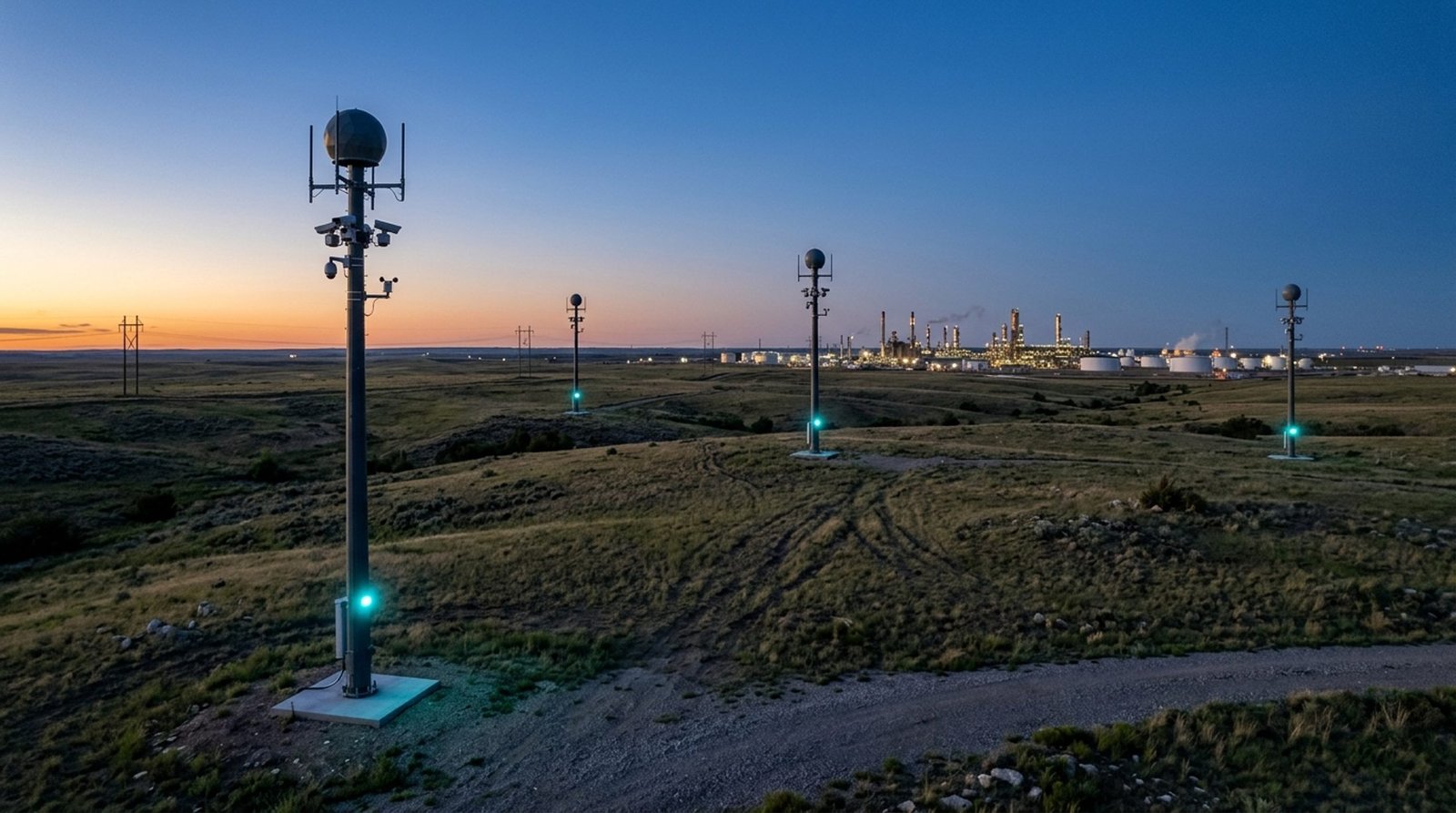
Acoustic, RF, radar, electro-optical, infrared, LiDAR, and neuromorphic event vision on every station. Each modality covers the others' blind spots — an RF-silent drone is still loud, warm, and physically present.
Neurex fuses sensors with Dempster-Shafer evidential reasoning — belief, disbelief, and explicit uncertainty. Instead of a mystery "55% threat," the operator sees "40% armed, 15% decoy, 45% uncertain — observing from Node C."
Every station runs full inference locally on edge AI hardware. Detection, classification, and prioritization happen at the node. Cut the network and every node keeps working — there is no link to sever.
The Canopy distributes tracking across nodes and understands formations — scouts, main body, reserve wave, decoys — then cues the operator with priorities, not just tracks. A human authorizes; the mesh executes the watching.
Because every station carries its own intelligence, adding nodes adds capacity linearly. Coverage scales by deployment, not redesign.
| Threat scale | Deployment | Architecture response |
|---|---|---|
| 10 drones · raid | 2–4 stations | Single Canopy cluster; each node tracks 3–5 targets |
| 50 drones · swarm | 4–8 stations | Distributed tracking and cueing across the mesh |
| 100 drones · mass attack | 8–16 stations | Sector-based responsibility with inter-sector handoffs |
| 1,000 drones · saturation | 16–40+ stations | Federated multi-Canopy coordination by sector |
A 50-drone raid against a facility protected by a six-station Canopy — detection through decision, with the human in command throughout.
Acoustic arrays, radar, and neuromorphic vision establish tracks on 47 of 50 targets. The three hidden in terrain shadow are flagged — with explicit uncertainty scores, not silence.
EO/IR classifies the swarm: 8 likely decoys, 32 probable attack profiles, 7 ambiguous. The ambiguous seven get more observation tasked automatically — not a guess.
Neurex presents a ranked engagement plan to the operator — priorities, confidence, recommended allocation. The human authorizes with a single confirmation. Machine speed, human judgment.
Precise coordinates, vectors, and priorities stream to partner response systems in real time. As the swarm maneuvers or splits, the Canopy redistributes tracking — and the audit trail records every decision.
We're building the intelligence layer for swarm defense — and working with defense partners, integrators, and investors who see the same problem.