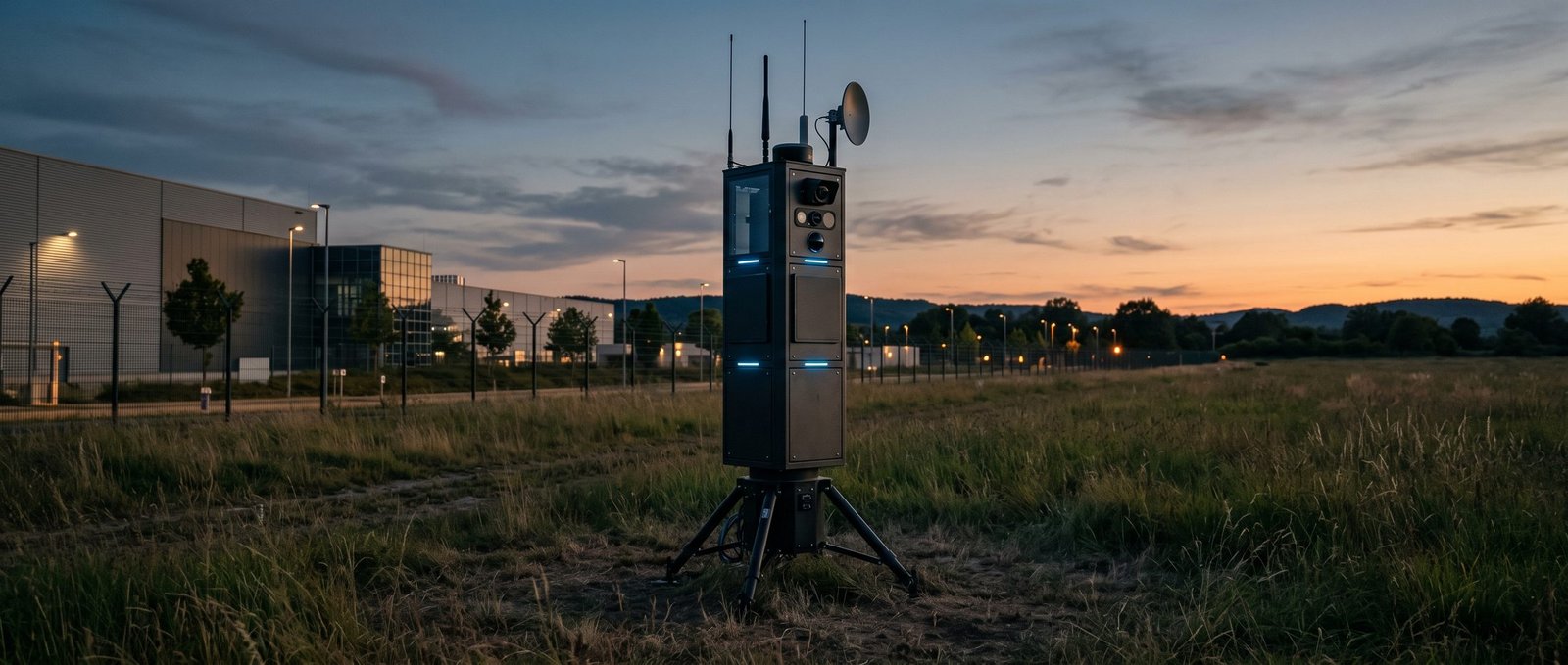
Volantyx Aerospace builds the autonomous intelligence layer for machines that must sense, decide, and coordinate with a human on the loop. Its first application is contested airspace — drone swarms, including the RF-silent threats no legacy system can see. The same architecture extends across enterprise networks, and by design every deployment in any environment makes the whole system smarter.
Swarms became the dominant threat because they are cheap. They became unstoppable because fiber-guided and autonomous aircraft emit nothing to jam — so the electronic-warfare layer that used to thin a formation does nothing at all. What remains is detecting, classifying, prioritizing and cueing dozens of simultaneous targets faster than they close. That is not a sensing problem and not a shooting problem. It is an intelligence problem, and it is the one we are built for.
| Incoming | Nodes | What the architecture does |
|---|---|---|
| 10 · raid | 2–4 | Single cluster; three to five tracks carried per node |
| 50 · swarm | 4–8 | Tracking and cueing distributed across the mesh |
| 100 · mass attack | 8–16 | Sector responsibility with inter-sector handoff |
| 1,000 · saturation | 16–40+ | Federated coordination across multiple clusters |
Across three nodes on our bench — the number a single-aperture sensor cannot produce at all.
Cut the network and every node keeps working. No central bottleneck to saturate.
Each node adds its own compute, so capacity grows with the threat rather than against it.
One ranked plan, one authorization. Machine speed, human judgment.
Concurrent-track capacity is measured on our own bench. Node counts are design targets for the station-class build, not fielded deployments — no integrated field validation has been completed to date. The full counter-swarm argument →
Every Volantyx business unit runs the same decision architecture — Neurex: edge-first autonomy, multi-source fusion, and privacy-preserving learning — applied to the environment where it matters most.
Counter-swarm AI defense for military and commercial aerospace — launch sites, BVLOS corridors, vertiports, and forward operating bases. Powered by Neurex, it detects, classifies, and tracks hostile drones — including RF-silent threats legacy systems cannot see — and cues a response with a human on the loop. The product line: Neura Sentry, Scout, Patrol, and Station, networked as Neura Canopy.
Privacy-preserving federated learning and agent trust infrastructure. Enables AI agents and distributed systems to learn, coordinate, and remain accountable across organizational boundaries — without moving the data.
Neura Defense Systems is the first deployment of the Volantyx architecture — an integrated detection and decision platform, in development for fixed-site and mobile use. One architecture, built first for contested airspace, extending into enterprise networks.
Facility threat assessments, quarterly intelligence reporting, and licensed threat data — built on the same multi-modal detection research behind the Neura platform.
Range awareness and airspace integrity for launch providers and spaceports — pad protection through the ascent corridor. Building a spaceport? Talk to us early.
Volantyx is built as a flywheel, not a portfolio. Intelligence earned in one environment compounds across all of them — the defense edge trains the network, and the network hardens the architecture that enterprise scales.
Defense deployments generate adversarial data no simulation can produce — real threats, real countermeasures, real edge conditions.
Federated learning moves intelligence without moving data. Every node gets smarter from every detection, and no sensitive data ever leaves its enclave.
Enterprise networks scale coordination across organizational boundaries — and feed the loop back to the edge, harder and smarter than before.
Three engineering principles govern everything Volantyx builds — from edge sensor fusion to federated enterprise coordination.
A 27-filing patent program covering the full stack — sensing and fusion, edge decision architecture, federated learning infrastructure, and coordinated autonomy. Thirteen provisional applications filed; fourteen more in preparation. See the platform running at demo.volantyx.com — request demo access.
Portfolio spanning both divisions / 2026Machines that must act in seconds cannot wait on humans, clouds, or luck. We build the intelligence that lets them decide.
Investors, partners, and program managers: the defense division is our lead program, the architecture is extending into enterprise networks, and the flywheel is turning.